

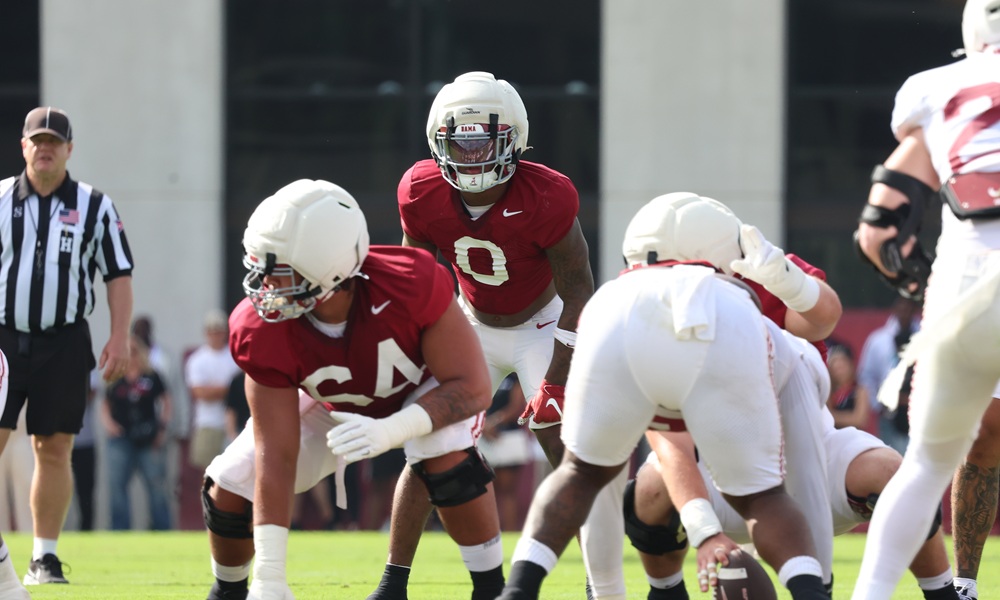
Following the conclusion of the 2025 season, depth at running back was immediately one point of concern for the Crimson Tide, mainly considering the underwhelming performance of the run game throughout the entirety of the season.

Although there was plenty of talent in the room, the running backs and offensive line were plagued by inconsistencies. What did the coaching staff do about the issue? It overhauled and arguably upgraded both positional groups.
The Crimson Tide saw the departure of three running backs: Jam Miller to the NFL Draft, Dre Washington to graduation and Richard Young to the transfer portal. But the Tide replenished itself, acquiring three new tailbacks.
By utilizing the transfer portal, Alabama secured former Tennessee and Appalachian State running back Khalifa Keith. Traditional high school recruiting efforts also allowed the Crimson Tide to secure commitments from two talented backs in in-state five-star Ezavier Crowell and three-star Trae’shawn Brown out of Huntsville, Texas.
With the three additions to offset the three losses, Alabama’s running back room for 2026 looks like this: junior Daniel Hill, redshirt sophomore Kevin Riley, redshirt freshman AK Dear, redshirt junior Keith and freshmen Crowell and Brown.
After spring practice, Hill and Riley are the clear frontrunners to start, which was expected. What wasn’t expected was Crowell suffering an injury, holding him back from early conditioning; meanwhile, the overlooked, late addition to the 2026 recruiting class, Brown, has been putting himself on the map early.
It’s becoming pretty clear that Alabama has plenty of talent and depth at running back; it may even have one of the best running back groups in the country. While that is certainly a good thing, one issue becomes glaring when taking a deeper look.
While depth at one position may not appear as an issue on the surface level, in the day and age of NIL and overlooked tampering, no immediate playing time is one of what could be the most minor issues that lead a player to listen to offers from other teams.
The days of players valuing loyalty, long-term development and waiting their turn are over, for the most part, at least. With six running backs that will have between one and three years of eligibility left after the 2026 season, head coach Kalen DeBoer and the Crimson Tide will need to either find the right selling point or balance of playing time to keep the talent they currently hold.
While the loss of a back like Hill to the NFL Draft would certainly sell itself to the younger players as a reason why they should stay, Alabama could still be left with five more talented backs, and a high school and transfer cycle to deal with.
At that point, it becomes clear that the Crimson Tide would have to make a decision: choose not to sign any top running backs in hopes of maintaining current depth and limiting transfers out, or sign one or two running backs and risk transfers out.
The issue is that no matter what decision the Tide makes, it yet again remains possible that Alabama will suffer departures due to the transfer portal because of the current culture of NIL. Whether the Tide adds more talent to the room or not, nobody ever knows what a player is going to do, like transfer, even if their team declines to add talent in hopes of maintaining that one player.
Furthermore, it remains possible that Hill does not leave. While Riley could end up being the one to breakout and declare for the draft, it’s quite possible, and maybe a little more realistic, that Alabama does not lose a back to the draft.
In a situation like that, the Crimson Tide would be in an even more complicated situation, as it would be left with six running backs, instead of an already potentially problematic five. In that circumstance, there’s bound to be transfers out.
Maybe the Tide loses one or two, maybe it loses three. Maybe Alabama only loses a couple of non-contributors, or maybe Riley and another key contributor decide they should go elsewhere; anything is possible. While the potential for the Crimson Tide to maintain all of them is a possibility as well, it’s extremely unlikely, given the current climate of college football.
After examining all of this, it becomes evident that losses will be imminent once the 2026 campaign comes to an end. In a year from now, it’s likely the room will yet again look different. It may be for the worst, it may be for the better, but changes are bound to happen, so it might be a bit too early for fans to get excited about what the future may hold with the depth that currently exists.
[/ihc-hide-content


TDA+
-


Alabama Football News
/ 2 days agoAlabama DB tells what Alabama has to do against Georgia QB Gunner Stockton

The Alabama Crimson Tide will face their biggest test of the 2026 season this...
-


Alabama Football News
/ 3 days agoWhy DeBoer is confident in Alabama QB Keelon Russell ahead of Georgia
The Alabama Crimson Tide will face the Georgia Bulldogs at Bryant-Denny Stadium this weekend. ...


